Work
Offline Semantic Verification & AI Data Q&A
An on-premise platform that semantically compares written interview records with speech transcripts, paired with a grounded AI data assistant.
Overview
A work project delivered as a fully on-premise system. Reviewers upload a written record together with the matching audio or video. The system separates speakers, transcribes the speech, reads the video watermark time to align the timeline, and then semantically compares the record with the transcript, annotating omissions, rewrites, and inconsistencies directly on the original document before exporting a verification report. An AI data Q&A module answers multi-turn natural-language questions about verification and business data with streamed text and charts. Every component, including the frontend, backend, speech services, and the language model, runs offline inside a closed network.
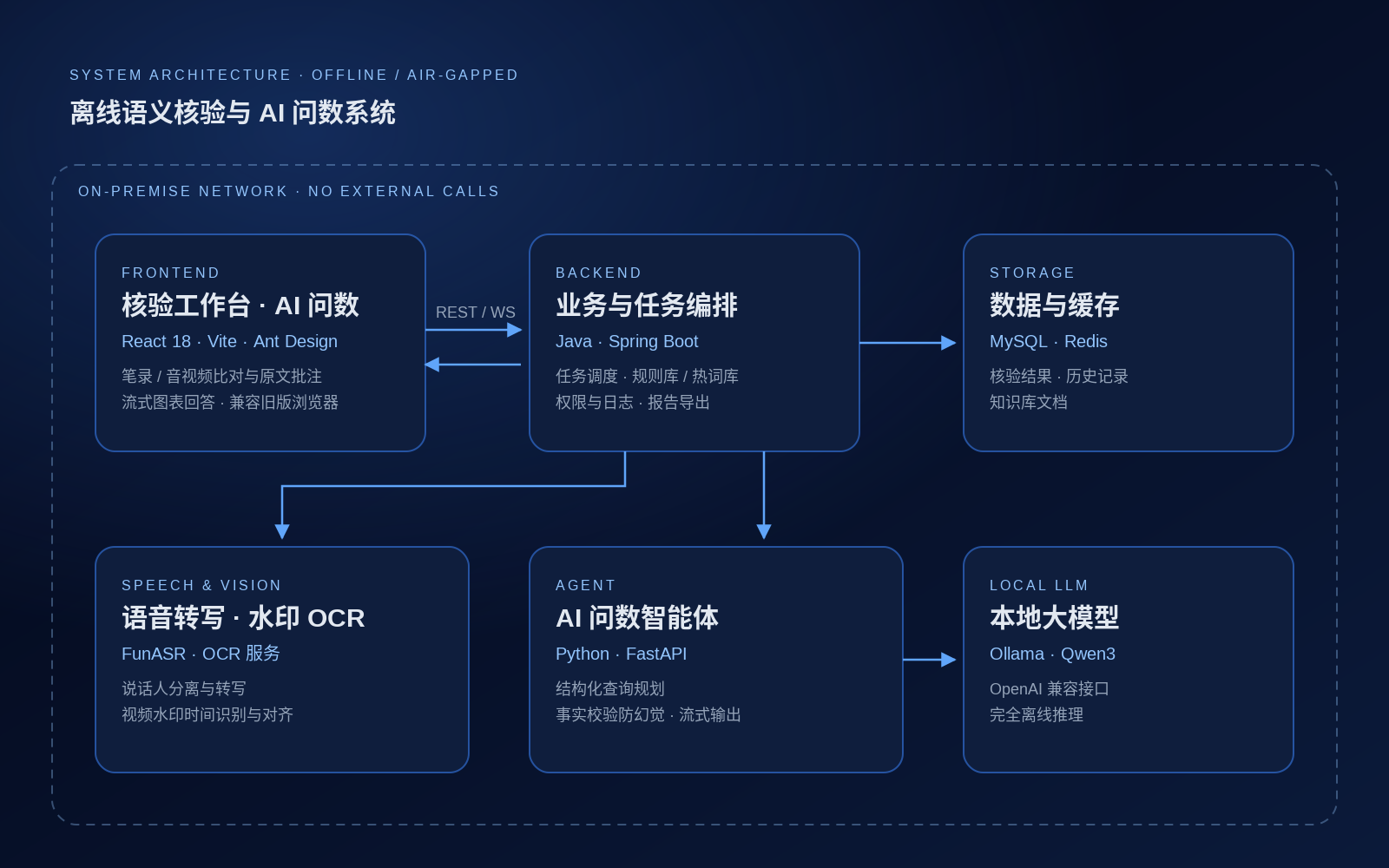
System architecture
Frontend, backend, speech and OCR services, the agent, and the local LLM all run inside a closed network.
Problem
Interview records had to be checked word by word against audio and video recordings. Doing it by ear was slow for every single record, and rewrites or timing mismatches were easy to miss. Staff also had to rely on fixed reports whenever they needed data.
My role
I was the frontend lead, owning the design and implementation of the verification workbench and the AI data Q&A chat: the task sidebar, upload and source linking, synchronized document and media preview, the results dashboard, and annotations on the original document. I also contributed across the rest of the system, including backend APIs, the agent answer pipeline, and the deployment plan.
Solution
The frontend uses React 18, Vite, and Ant Design. A Java Spring Boot backend handles task orchestration, rule libraries, and report export. FunASR performs speaker diarization and transcription, and a watermark OCR service reads video timestamps for alignment. AI data Q&A runs through a Python FastAPI agent that plans structured queries, calls a local Qwen3 model on Ollama, and streams text and charts back. The core workflow is: upload record and media, transcribe and align, run the semantic diff with annotations, review, and export the report.
Outcome
Verification shifted from manual word-by-word comparison to machine comparison with human review, so reviewers only focus on flagged differences. AI data Q&A lets staff query data in plain language with traceable answers.
Technical highlights
- Fully offline, air-gapped deployment with local models and speech services
- Speaker diarization with renaming, transcripts shown per speaker
- Watermark OCR reads video time to align record and recording timelines
- Semantic diff with differences annotated on the original Word / PDF
- Anti-hallucination fact-grounding layer: every number and status must be backed by query results
- Structured query planner handling relative dates and multi-turn references
- Streaming answers with rich text and ECharts charts rendered together
- Legacy browser support down to Chrome 69 for closed-network machines
Lessons
Bringing LLMs into high-stakes work is less about model strength than about boundaries: let the model understand and phrase, let data and rules own the facts, and make every conclusion checkable.